

Low unemployment, plenty of labour: what does it imply for wage pressures?
By Oscar Arce and David Sondermann
Euro area unemployment is near record lows and set to fall further. Yet wage growth is projected to moderate. Paradox? Not if you look beyond unemployment – immigration, participation, job switching and firms’ hiring intentions are all part of the story.
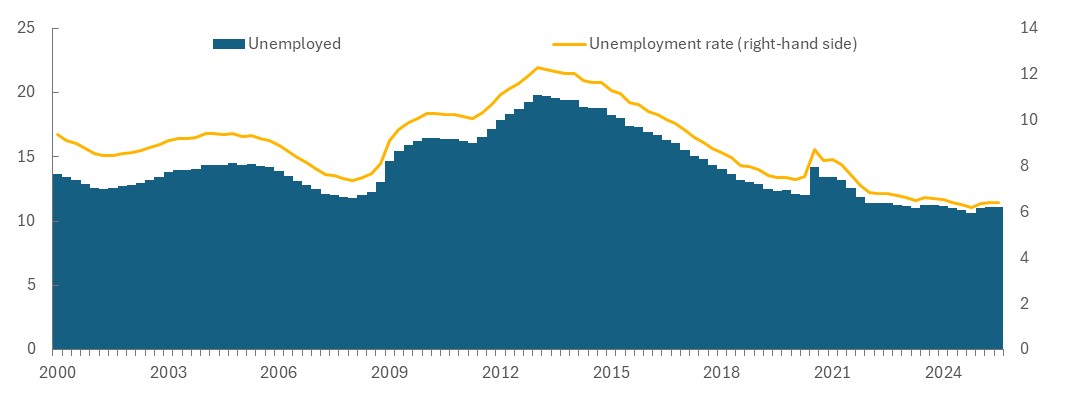
Slack in the labour market is a key input into monetary policy assessments of wage growth and inflation.[1] It is about the balance between effective labour supply and firms’ demand for workers. The unemployment rate has traditionally served as the central indicator of labour market slack in policy discussions. In the euro area, this rate has been close to its record low for some time now (Chart 1). It is projected to fall even further in the next three years. Over the same period, wage growth is also projected to decelerate. This combination seems puzzling because the classic Phillips curve relationship predicts that a lower unemployment rate would make firms bid up wages to attract workers.
Chart 1
Euro area unemployment
(left-hand side: millions of unemployed; right-hand side: unemployment as a percentage of the labour force)
Source: Eurostat, Labour Force Survey, latest observation: Q3 2025.
This blog post takes a closer look at labour market mechanics to make sense of the combination of low unemployment and the projected deceleration of wage increases. We argue that focusing on the unemployment rate alone falls short and can be misleading. At times, unemployment captures the supply-demand balance less well, in particular when labour supply and demand adjust along several additional margins. And these margins have become more important in recent years.
The labour force is growing
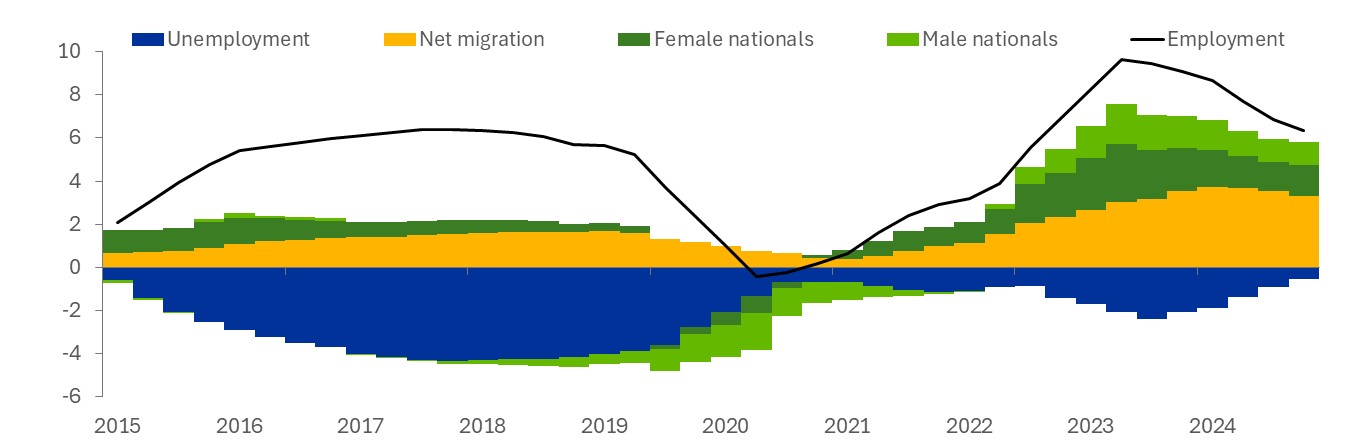
How have firms satisfied their demand for additional workers over time? Employment growth can be broken down into the changes in unemployment and workers that joined the labour force (Chart 2). Following the recovery from the great financial crisis and the sovereign debt crisis, the pool of unemployed remained the key adjustment margin. After the pandemic, however, the number of people unemployed has not changed as much anymore. So how were the additional 6 million jobs in the last three years filled?
Chart 2
Contribution to changes in employment
(three-year average changes; in millions of employees)
Source: Eurostat, Labour Force Survey.
Notes: Four-quarter moving average of three-year changes in employment and its contribution from changes in migration, changes in the domestic labour force (female and male separately displayed) and changes in unemployment. Negative changes in unemployment indicate, on balance, positive contributions to employment.
On balance, the pool of unemployed contributed only about 500,000 to the additional 6 million jobs created in this period. By contrast, more than 3 million additional jobs were filled by people immigrating into the euro area. In turn, about 2.5 million more jobs were taken by previously inactive nationals – people who had not been seeking employment. Of those 2.5 million joining the labour market, 60% were women.
Admittedly, both the increase in female participation and net inward migration had already supported employment growth before. But their contribution in recent years has been much stronger than usual. Foreign workers added around 53% to the employment creation, compared with 29% between 2015 and 2019. Similarly, more nationals were activated, contributing 43% to job creation, compared with a 9% increase in 2015-19. And the contribution from the pool of unemployed has not always been negligible in the past – it had been the main contributor to filling jobs (63%) in the years 2015-19.
At the same time, the participation of older workers has increased noticeably over time. With growing life expectancy, workers tend to start retirement later. Since the third quarter of 2022, the participation rate of 55-74-year-olds has increased by nearly 1.7 percentage points. Compared with previous generations, more than 1.5 million additional older workers remained an active part of the labour force. This was not entirely new, though. The increased participation was already visible in the pre-pandemic years, when the older-age participation rate increased by 3.2 percentage points (2016-19).
Overall, this evidence illustrates how, despite the relatively minor role of changes in unemployment, firms’ labour demand could be satisfied during the previous three years. And it points to the significant elasticity of the margin of foreigners drawn into the euro area labour market and that of nationals that can still be activated. Therefore, the available labour supply has been larger than implied by the changes in the number of unemployed alone. This has helped easing labour market tightness and wage pressures.
In the coming years, according to the projections of the European Commission, these factors are expected to sustain an elastic labour supply and contribute to alleviating market tightening pressures. Longer-term, though, the ageing of the national population is likely to reduce the labour force in the euro area (by around 11 million up to 2035), unless net immigration and higher participation can be sustained.
Additional labour supply: the marginally attached and underemployed
The unemployment rate is already low in the euro area, and it may decline further. In several countries, it is not yet at its historical low. Moreover, previous structural reforms in Member States might have reduced the structural unemployment rate. Who else could enter the labour market?
In addition to the unemployed, nearly 7 million people in the euro area are generally willing to work, but they are currently either not available or not actively searching (the “marginally attached”). This could, for example, be people temporarily caring for a family member. In addition, around 5 million workers are underemployed. They would like to work more hours than they are currently employed for. Levelling them up to their desired hours would be tantamount to around 2 million additional workers.
What job-to-job transitions tell us about tightness
The pool of employed workers switching jobs is also an essential indicator of slack and wage pressures. When firms find it more difficult to recruit additional workers, they often start poaching people in employment. They offer better employment conditions, including higher pay, to incentivise workers to switch jobs. The number of employees that move jobs varies significantly with the business cycle. It is usually between around 4 and 7 million employees per year (3% to 5%). Currently, we see that fewer workers are switching jobs. The ECB’s Consumer Expectations Survey provides up-to-date quarterly data of job switching and suggests that job-to-job transitions have lost momentum in previous quarters. This is likely reflecting the fact that firms’ willingness to provide better job offers has declined and more workers are preferring to stay put. And that in turn indicates a less tight labour market.
Chart 3
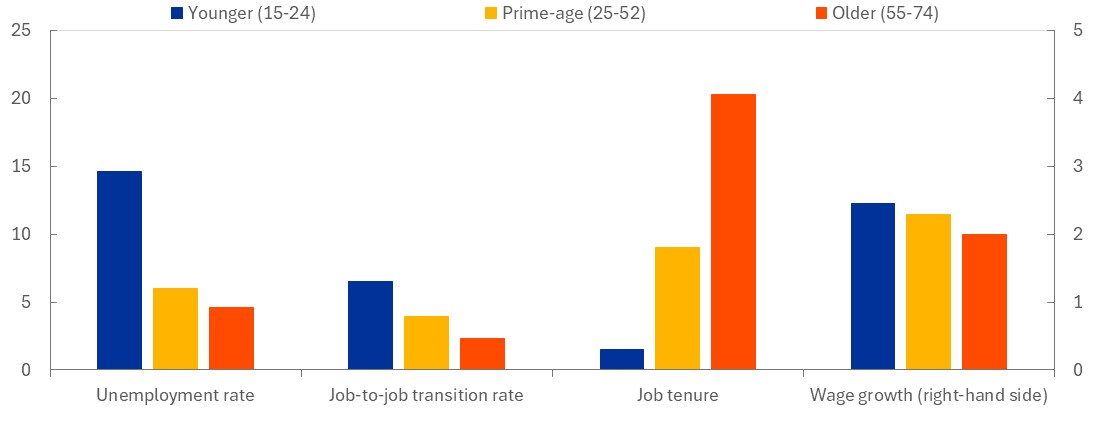
Labour market outcomes by age group
(for unemployment rate: percentage of labour force; for job-to-job transition rate: percentage of employed; for job tenure: years; for wage growth: annual percentage growth (right-hand side))
Sources: Eurostat, Structured Earnings Survey (SES), Arlia et al (2025) using IAB, Ministerio de Inclusión, Seguridad Social y Migraciones, Insee and ECB calculations.
Notes: Unemployment rate (average 2022-25), job-to-job transition rate (average 2019-21); job tenure (average 2022-24); wage growth: average annual growth of hourly earnings (2014-22). For wage growth, the age categories as present in the SES are slightly deviate: young (less than 30), prime-age (30-49), older (50+).
Structural trends also play an important role. With an ageing society in Europe, the share of older workers increases every year. This gradually changes the labour market. Social systems in Europe with strong employment protection and collective agreements typically shield longer-tenured workers from dismissal. Chart 3 shows that average tenure on the job increases from two to 20 years with age. People with a longer tenure have a lower risk of being laid off. During the last three years, older workers’ unemployment rate was (at 4.5%) significantly below that of the prime-aged (6%) or that of the young (around 14.6%). They are also less likely to look for a new job. Annual transition between jobs fall along the age brackets from around 6.5% to 2% of all people in employment. This implies that older workers are also less likely to renegotiate their wages. In fact, increases in annual hourly wage growth is lowest for the age brackets of the older worker. Overall, lower job-to-job transitions, cyclically and structurally, would indicate lower tightness in the labour market and wage pressures as the labour force gradually ages.
The role of firms’ labour demand
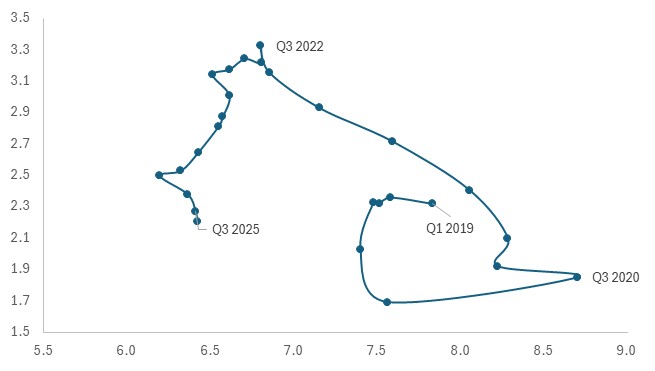
Only looking at labour supply misses firms’ need for additional workers. Lower labour demand does not always show up in more layoffs and higher unemployment. At times, firms might hoard labour to temporarily overcome difficult situations. Chart 4 illustrates this by showing the relationship between job vacancies – a proxy for labour demand – and unemployment, the “Beveridge curve”.
Chart 4
The relation between firms’ labour demand and the unemployment rate
(x-axis: unemployment rate (percentage of labour force); y-axis: job vacancy rate (percentage of filled and unfilled jobs))
Source: Eurostat.
In periods of strong economic downturns, firms adjust their number of staff more drastically. This is mirrored in a rise in the economy’s unemployment rate. The COVID-19 pandemic as seen in Chart 4 is a recent example. Yet, when facing a modest slowdown, firms might simply favour hiring less or just not replacing retiring staff, without necessarily laying people off. Chart 4 shows that this has been happening since mid-2022. Firms posted fewer job openings without laying people off and thus without triggering a rise in the unemployment rate. As a result, fewer openings per unemployed are available now. This lower labour demand indicates less competition among firms for additional workers. This should, all else equal, translate into lower wage pressures than what the historically low current level of unemployment might suggest.
A cooling labour demand is not only reflected in fewer hires, but also in lower average hours worked. Indeed, more than 80% of firms accommodate fluctuations in product demand by adjusting the hours worked by their employees. Take the last business cycle before the pandemic (2013-19). From trough to peak, euro area citizens worked around five hours more per quarter.[2] This might not sound like a lot. But again, put into full-time equivalent, this is a difference of 2.2 million jobs. Also during the pandemic, hours worked per employee decreased significantly and they still remain below pre-pandemic levels. But they have been picking up again most recently. A sign that labour hoarding of firms, that was high during the pandemic and the energy price shock, declined. Hours are another margin firms can use to boost their effective labour without necessarily implying additional wage pressures. Beyond the cyclical dimension, average hours worked in the euro area are also structurally below those elsewhere, like the United States. This also reflects a preference in Europe towards working fewer hours per week.
Conclusions
Assessing labour market slack requires a broader perspective than the unemployment rate alone. It needs to consider both supply and demand dynamics across the full range of the labour market. Labour supply can change due to migration, participation, underutilisation and hours worked, while labour demand may weaken without triggering layoffs. The increasing importance of these broader adjustment channels helps explain why wage growth can continue moderating even as unemployment remains at record lows. This circumstance, which is coherent with the Eurosystem macroeconomic projections, reflects the fact that the labour market is less tight than the unemployment rate alone would suggest.
The views expressed in each blog entry are those of the author(s) and do not necessarily represent the views of the European Central Bank and the Eurosystem.
Check out The ECB Blog and subscribe for future posts.
For topics relating to banking supervision, why not have a look at The Supervision Blog?
Legal Disclaimer:
EIN Presswire provides this news content "as is" without warranty of any kind. We do not accept any responsibility or liability for the accuracy, content, images, videos, licenses, completeness, legality, or reliability of the information contained in this article. If you have any complaints or copyright issues related to this article, kindly contact the author above.
